March 28, 2026
Same Bids, Different Results: The Amazon Ads Illusion
In Amazon Advertising, it’s easy to assume that higher bids lead to better visibility—and ultimately, better performance. But seasoned advertisers know that it’s not just about how much you bid. It’s about where that bid is applied.
One of the most misunderstood aspects of Amazon Ads is the relationship between base bids and placement multipliers. On paper, two campaigns can look identical in competitiveness, yet behave very differently in terms of spend efficiency and return. This subtle distinction often separates average-performing accounts from highly optimised ones.
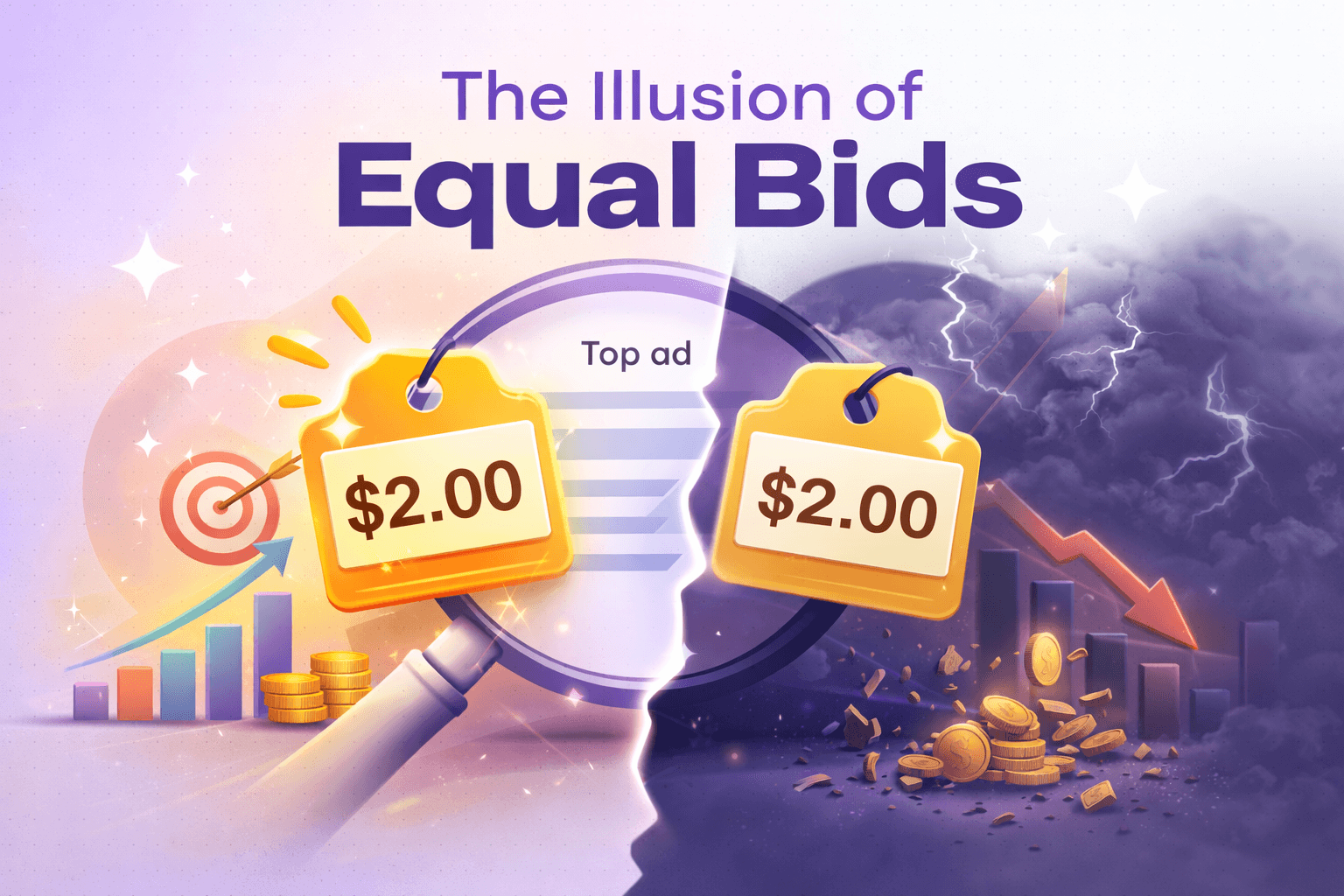
The Illusion of Equal Bids
Let’s consider a common scenario.
Two campaigns are set up differently, yet both aim to achieve the same level of competitiveness at the most valuable placement—Top of Search.
Campaign A uses a lower base bid with a high placement multiplier
Campaign B uses a higher base bid with a lower multiplier
At first glance, both strategies can result in the exact same bid for Top of Search. This creates the illusion that they are interchangeable.
But they’re not.
What’s Really Happening Behind the Scenes
Amazon calculates your final bid using a simple formula:
Final Bid = Base Bid × (1 + Placement Multiplier)
While this ensures both campaigns can compete equally for premium placements, it also reveals something more important:
👉 Your base bid doesn’t just affect one placement—it affects all of them.
This is where the divergence begins.
A higher base bid doesn’t just make you more competitive at the top—it also raises your cost across Rest of Search and Product Pages, regardless of how those placements perform.
The Hidden Cost of Broad Bidding
In most Amazon accounts, placement performance tends to follow a familiar pattern:
Top of Search → Highest intent, strongest conversion rates
Rest of Search → Moderate performance
Product Pages → Lower intent, often weaker returns
When you increase your base bid, you’re effectively choosing to pay more across every placement—including the ones that don’t convert as efficiently.
This is where many campaigns begin to lose efficiency without a clear reason.
The issue isn’t always targeting or creatives—it’s often bid distribution.
Precision vs Exposure: A Strategic Choice
This brings us to a fundamental decision every advertiser needs to make:
Do you want controlled precision… or broad exposure?
A lower base bid with a higher Top of Search multiplier is a precision-driven approach. It allows you to:
Compete aggressively where it matters most
Limit spend in lower-performing placements
Improve overall efficiency
On the other hand, a higher base bid with a lower multiplier increases your visibility everywhere—but often at the cost of profitability.
You gain reach, but lose control.
Aligning Bids with Real Performance
The most effective Amazon advertising strategies are not built on assumptions—they are built on placement-level data.
If your campaigns show that:
Top of Search drives the majority of conversions
Product Pages underperform
Rest of Search delivers inconsistent returns
Then your bidding strategy should reflect that reality.
Rather than spreading your budget evenly, it becomes more effective to concentrate aggression where conversion probability is highest.
A Smarter Way to Scale
As accounts mature, advertisers begin to move away from uniform bidding and toward intent-driven bidding strategies.
A common approach includes:
Maintaining a moderate base bid to control baseline costs
Using higher multipliers to dominate high-intent placements
This ensures that incremental spend flows into the most profitable areas—rather than being diluted across weaker ones.
Final Thoughts
Amazon Ads is often perceived as a bidding game—but in reality, it’s a control system.
Every bid you set is not just a number; it’s a signal to Amazon about:
Where you want visibility
Where you are willing to spend
And where you expect results
Understanding the difference between base bids and placement multipliers allows you to move beyond surface-level optimization and into intentional, performance-driven strategy.
Because in the end, success on Amazon isn’t about bidding more—
it’s about bidding smarter, with purpose.